Building Informed and Involved Communities for Responsible Marine Carbon Dioxide Removal – A Workshop Series
Program Areas – Responsible Innovation, Education and Engagement
Workshop 1: Community Capacity Gaps for Responsible mCDR
First of two Expert and Stakeholder Workshops on Building Informed and Involved Communities for marine Carbon Dioxide Removal (mCDR)
Date & Location:
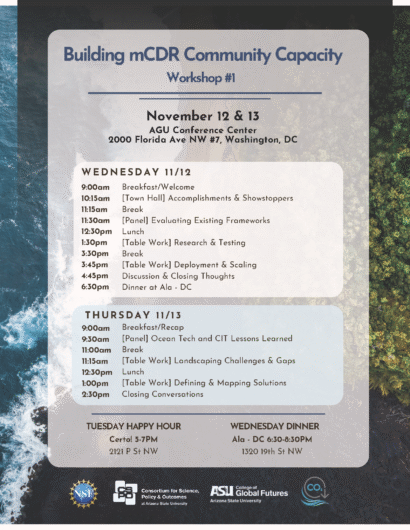
- November 12 & 13 2025, at the American Geophysical Union Conference Center – 2000 Florida Avenue, NW, Washington, D.C., 20009
Background:
This NSF-supported invitation-only workshop series brings together a diverse group of mCDR, ocean, and social science stakeholders, researchers, and practitioners to identify the challenges of building community capacity for mCDR through different stages of research, testing, and deployment, and developing a plan of action for the public, private, and philanthropic drivers.
With respect to mCDR research and development, this first workshop aims to:
- Convene a representative group of experts, stakeholders, and decision-makers,
- Assess existing and proposed ethical frameworks for responsible innovation,
- Identify technology development pathways and related community capacity needs for reaching different technological readiness levels based on knowledge and experiences from mCDR and relevant fields, and
- Develop a roadmap identifying the community capacity gaps and needs to inform the design, development, and convening of the second workshop on building informed and involved communities, focusing on outlining community capacity solutions in the near, medium, and long term.
The workshop agenda and design have been developed based on (a) review of the existing literature on mCDR R&D, (b) interviews, meetings, workshops, and engagements with experts and stakeholders, and (c) guidance from our seven-member advisory board.
Guiding Questions:
- What does “community capacity” look like for different mCDR technologies?
- What is the level of community involvement needed in each technology?
- Are there existing community structures to support mCDR?
- Where does technology readiness meet community readiness?
- What existing frameworks are there for mCDR, and should those be updated to better support community capacity building and engagement?
- What lessons can be learned from past technologies in ocean communities, and what lessons are already being learned with mCDR approaches?
Workshop 1 Agenda:
Preliminary Results:
Workshop by the numbers –
- 28 workshop participants
- Across 19 organizations from Academia, Startups, Industry, Policy, Governance/Law, Environmental Justice, Indigenous Engagement, Community Engagement, Social Sciences, etc.
Major Hopes:
- Increase in legislation, federal engagement/support, engagement of state and local levels, with robust governance frameworks
- Incorporation of community engagement models and responsible development with EJ, education, community engagement, and broad participation.
- Scientific support that mCDR works
- mCDR becomes better situated in the broader climate change conversation and mitigation landscape
- Greater financial investment for research and development from the government, industry, philanthropy, etc.
Major Concerns:
- Loss of focus on climate change science, public perceptions, and mitigation research
- Bad or rogue actors impeding progress for mCDR
- Stall or loss of momentum on progress from …
- Lack of funding
- Tension between actors in and around the mCDR field (NGOS, conservation groups, EJ groups, etc.)
- Mismatched pace of governance, markets, and R&D
High Priority Challenges:
-
Ensuring 3rd party support in engagement activities, such as a community liaison
- Assessing what problems mCDR can solve beyond carbon removal
- Defining technical showstoppers for the scalability of each mCDR technology
-
Activating and enabling US leadership
- Building robust community engagement structures
- Rethinking and adapting governance frameworks
For more results, you can download our poster presentation here – AGU ’25 mCDR poster – from the 2025 Annual Meeting of the American Geophysical Union in New Orleans, LA, December 15-19.
Contact and Further Information:
- Mara Karageozian, [email protected]