American Science@250: Rethink, Reimagine, and Redesign
Program Areas –
American Science@ 250: Project Updates
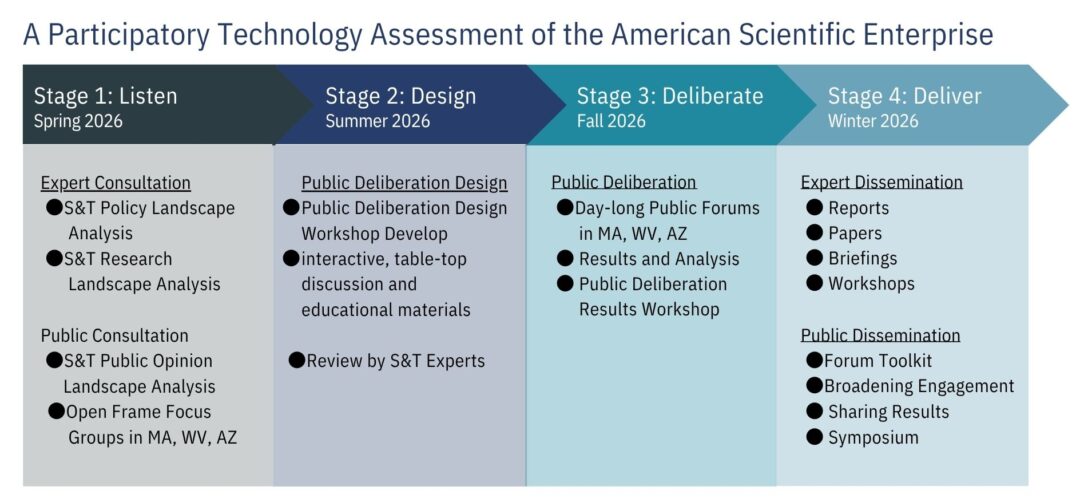
Stage 1 included commissioning two landscape analyses: (a) Snapshot of the Current U.S. Science Landscape and (b) Horizon Scan of the U.S. Science Policy Ecosystem. It also included the convening of three open-frame community dialogues:
- Museum of Science, Boston, May 11th & 12th, 2026
- Arizona Science Center, Phoenix, May 16th, 2026
- Jackson’s Mill, WV, May 30th, 2026
During these dialogues, 10-15 members of the public were given minimal background information and asked about their hopes and concerns regarding knowledge, learning, and the past, present, and future of their communities, as well as public support and priorities for science and technology.
Preliminary findings from these dialogues included:
- Finding 1 – Societal outcomes of research. Participants highlighted the societal outcomes of research, science, and technology in discussions about the past, present, and future.
- Finding 2 – Science and learning as important endeavors. In addition to finding 1, many participants discussed science and learning important and worthwhile endeavors worthy of public investment regardless of its contributions to specific societal, technological outcomes.
- Finding 3 – Low confidence in federal government’s ability to make decisions about science. Participants were deeply skeptical of governing institutions and their past and present decision making about science.
- Finding 4 – Variety of perspectives for governing publicly-funded research. Participants discussed the importance of a variety of values and considerations regarding governing publicly-funded research.
Stage 2 involved convening a public deliberation design workshop on June 18th, 2026, in Washington, D.C. with science and policy experts and stakeholders to gather advice and guidance on the topics, questions, content, and outputs of the three public forums.
Preliminary themes emerging from the workshop include:
- There is no one science or scientific enterprise. Higher education functions differently from national labs; environmental science operates differently from materials science and engineering. Likewise, trust and confidence in these institutions are multifaceted. Deliberative activities should attend to this diversity.
- The public should learn from and inform the “civics of science policy”–who defines the public good, who makes decisions about research topics and funding, who conducts research, etc.
- Public deliberations should explore a variety of expectations about “the social contract of science” to allow the public to weigh their own priorities and explore the outcomes, mechanisms, and processes they wish to see in publicly funded science.
To learn more about our Stage 1 and Stage 2 activities, read our American Science@ 250 Workshop Briefing Document that was distributed to our June 18 workshop participants.