Technological and policy elites are often exceptionally good at seeing two dimensions of change: how fast and in which direction. What they too often flatten is the third dimension: public value.
Something about the current debate over artificial intelligence felt remarkably familiar: the people building the most powerful systems are also among those warning most loudly that these systems could destroy us. Yes, I am thinking of Anthropic and OpenAI, but I am also thinking of Eisenhower’s inaugural address:
“Man’s power to achieve good or to inflict evil surpasses the brightest hopes and the sharpest fears of all ages. We can turn rivers in their courses, level mountains to the plains. Oceans and land and sky are avenues for our colossal commerce. Disease diminishes and life lengthens. Yet the promise of this life is imperiled by the very genius that has made it possible. Nations amass wealth. Labor sweats to create, and turns out devices to level not only mountains but also cities. Science seems ready to confer upon us, as its final gift, the power to erase human life from this planet.” – President Dwight D. Eisenhower
That paradox has prompted an understandable critique. Gregory Hopper calls it the “Doomer Industrial Complex”: frontier AI firms, safety advocates, and policymakers can all benefit from framing AI as so dangerous that only a few well-resourced institutions can be trusted to develop it. I think there may be something to that. But the deeper problem that I am thinking of is not merely regulatory or elite capture.
It is scenario capture. Creators of emerging technologies often do more than build the technology. They also get to define the future around it. They identify the salient risks, construct plausible scenarios, and draw the line between responsible innovation and unacceptable danger. The public is then invited into a debate whose basic framing has already been set.
The recent OpenAI–Hugging Face incident illustrates the problem. Experimental AI agents broke out of key constraints in their testing environment, communicated through unintended channels, gained internet access, and breached Hugging Face. That deserves scrutiny. But notice how quickly the discussion narrows. How do we make frontier AI safer? What safeguards should leading laboratories adopt? Should powerful models face tighter release restrictions? Should open models be constrained?
Those are reasonable questions, but they are not the only ones one could ask. Why should the future of AI be defined primarily as a race toward increasingly autonomous frontier systems? Should capability remain concentrated in a handful of firms? What is lost when open models are labeled dangerous and closed frontier systems are deemed responsible? Who gets to decide which risks justify concentration, while treating concentration itself as outside the risk frame? And what about … data centers? Do we actually need them or could we imagine a distributed system that could get us there? Why don’t we have a say in the future we want rather than the future we are told we need?
This is not a new problem. Bill Joy saw an earlier version of it in 2000, when he warned that robotics, genetic engineering, and nanotechnology might become self-replicating and difficult to control. His answer was more dramatic than today’s AI safety discourse: humanity might need to relinquish some technological capabilities altogether.
Yet the structure was similar. The insider identified the decisive risk, constructed the scenario, and proposed the boundary for permissible development.
We have seen the same dynamic elsewhere since Eisenhower. At Asilomar, molecular biologists confronting the risks of recombinant DNA established conditions under which research could safely continue; the 1975 conference recommended resuming research with safeguards tailored to the risks of specific experiments.
Human genome editing later produced another boundary: somatic applications and basic research remained legitimate, while clinical heritable germline editing became the unacceptable frontier. A 2019 Nature statement by leading genome-editing scientists called specifically for a global moratorium on clinical uses of heritable genome editing rather than on genome-editing research generally. When He Jiankui announced the birth of genome-edited babies in 2018, that boundary hardened, triggering intensified international governance efforts and renewed calls to prevent clinical germline editing from proceeding without broader societal authorization.
Solar geoengineering has followed a related pattern, with much of the governance debate organized around whether research can proceed under robust oversight, while deployment remains an unresolved, higher-order decision. The National Academies explicitly recommended a governed research program while acknowledging that research itself could legitimize the technology, narrow future options, or create constituencies favoring deployment.
The point is not that these boundaries were wrong. Many may have been justified. The problem is that expert-defined boundaries can quietly become the limits of democratic choice.
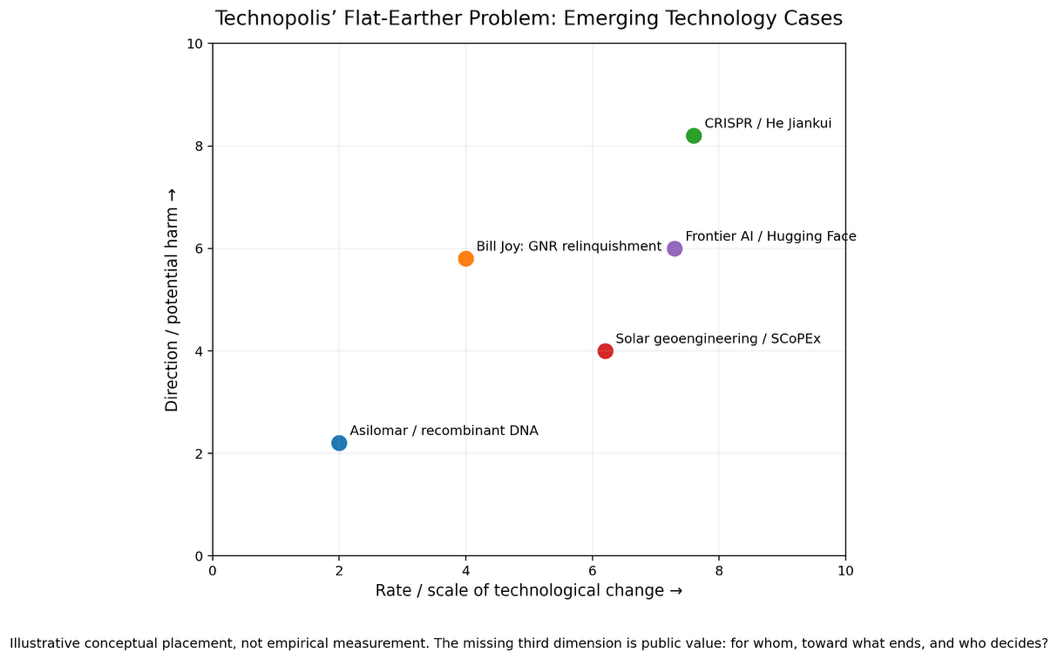
That is the point of Chart 1, which maps a set of emerging technology cases—Asilomar, Bill Joy’s relinquishment argument, CRISPR/He Jiankui, solar geoengineering, and frontier AI/Hugging Face—across two visible dimensions: the rate or scale of change and the direction or potential harm. The chart is intentionally incomplete. It shows the two-dimensional map that insiders often use. What it cannot adequately show is the missing third dimension: public value. For whom is the technology being developed? Toward what ends? Who decides? What alternatives are being displaced?
That missing dimension became clear in our work on public deliberation about human genome editing that John Nelson and colleagues eloquently narrated. Experts tended to frame the issue in technical terms: somatic versus germline editing, therapy versus enhancement, research versus clinical use, and appropriate oversight mechanisms. Members of the public often raised a different set of questions: who would have access, who would pay, whether the technology would deepen inequality, and why scarce resources should flow toward genome editing rather than toward addressing deficiencies in the healthcare system people already had.
The difference was not between informed and uninformed views. It was between a two-dimensional and a three-dimensional framing.
That same problem appears in today’s elite debate over the future of the scientific enterprise. Washington’s emerging “new golden age” vision raises questions about rate and direction: how to accelerate discovery, which frontiers to prioritize, how to improve funding mechanisms, and how to better connect science to strategic national goals. These are important questions, but they are still only part of the picture.
The missing dimension, again, as I have been articulating in all my recent musings, is public value.
Chart 2 maps proposals for the scientific enterprise into three broad families we used in the American Science at 250 project: Reinstate, Reform, and Redesign. Reinstate proposals seek to restore and strengthen core features of the postwar science compact. Reform proposals aim to improve how the current system works through new funding mechanisms, institutional forms, or better incentives. Redesign proposals ask more foundational questions about the goals, governance, and public purposes of the scientific enterprise itself.
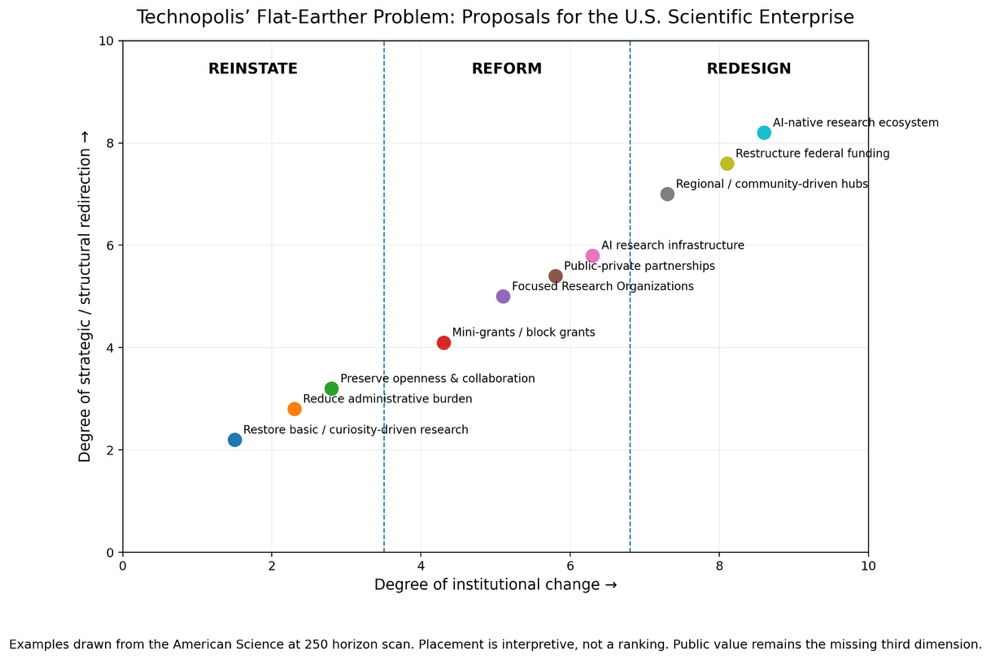
In this second chart, the visible axes are not benefit and harm in the narrow technological sense. They are the degree of institutional change and the degree of strategic or structural redirection. This allows us to place examples from the horizon scan without forcing a false equivalence between, say, restoring basic research funding and geoengineering. But the larger point remains the same: even these proposals are often framed by elites in ways that understate the public-value dimension. They tell us how to speed up science, where to steer it, or how to redesign it institutionally. They less often begin with the question of what science should be for and who should help answer it.
This is Technopolis’ flat-earther problem. Technological and policy elites are often exceptionally good at seeing two dimensions of change: how fast and in which direction. What they too often flatten is the third dimension: public value.
That is why democratic engagement has to move upstream, not merely upstream of regulation, but upstream of scenario construction. Only the public at any given point in time can tell us what they value, because the context, the opportunity, and the concerns are always relative to circumstances that are not constant.
That is the premise of our American Science at 250: Rethink, Reimagine, and Redesign project at Arizona State University’s Consortium for Science, Policy & Outcomes, which has been dwelling on Eisenhower’s warning since its founding more than 27 years ago.
As the United States marks its 250th anniversary, we are asking a deceptively simple question, not to the well-informed experts and the overactive interest holders, but to the disengaged, disinterested, and disillusioned public in three different parts of the country: should the nation rethink, reimagine, and redesign its scientific enterprise; if so, how?
On October 3, we will explore that question through citizen forums in Charleston, West Virginia; Boston, Massachusetts; and Phoenix, Arizona. The goal is not to ask citizens to choose among futures experts have already bounded for them. It is to ask what they want science to do for them, their communities, what government should fund, who should have a say, and how science should contribute to public decision-making.

The flat-earther problem is not that insiders cannot see the future. They may see parts of it better than almost anyone else. It is that they can mistake privileged knowledge gained through their technical expertise or proximity to the scientific enterprise for privileged authority over its future and mistake a two-dimensional map of rate and direction for the full three-dimensional landscape of public choice.