The OSTP report presents itself as a fundamental rethinking of the linear model of innovation, ignoring that the system has been adapting to the inadequacies of that model for over half a century.
Don E. Kash was about the age I am now when I enrolled in his seminar, Technology, Science, and Public Policy, in the fall of 1997. Before becoming the Hazel Chair of Public Policy at GMU, he held faculty positions at the University of Oklahoma, where he was the founding director of the science and public policy program. Don’s public service career, in addition to serving on several committees of the former Congressional Office of Technology Assessment, included a pivotal role in the second half of the Carter administration as chief of the U.S. Geological Survey’s Conservation Division.
Almost 15 years later, our paths would cross again at a New America Foundation Event on governing an uncertain technological future. Don, who chaired my PhD committee, was an invited speaker, alongside my other intellectual mentor and colleague, Dan Sarewitz, CSPO’s founding director.
I remember Dan describing Don to me as “a very wise man.” I didn’t need to ask him why; I had my own list of Don’s wisdom. One of them was a curious omission from our reading list that fall: Vannevar Bush’s Science, the Endless Frontier.
In its place, Don’s long list of chronological readings, which began with Ernst Cassirer’s “Galileo: A New Science and A New Spirit” and ended with Okimoto’s Between MITI and the Market, included Lost at the Frontier: U.S. Science and Technology Adrift by Deborah Shapley and Rustum Roy.
Wise Don wanted his students in science and technology policy to learn about the linear model by studying its limitations, which, in the mid-1990s, was not a matter of contention among science and technology policy scholars like Don or leaders like Eric Bloch, the NSF director under Ronald Reagan, and Tom Ratchford, the associate OSTP director under George H. W. Bush, two visiting faculty at GMU during my doctoral studies.
In fact, Tom had a slightly different approach. He would compare Bush’s model of innovation with Niels Bohr’s model of the atom, which helped explain atomic spectra and opened the door to quantum theory. But Bohr’s model was also incomplete. Electrons do not actually orbit nuclei like planets around the sun. The Bohr model cannot adequately describe wave-particle duality, uncertainty, probability distributions, or the behavior of complex atoms. Quantum mechanics eventually provided a richer account.
Tom’s point was that Models are abstractions. Good ones capture enough of reality to help us understand and act. Their usefulness does not require completeness, and their incompleteness does not make them failures as long as we make corrections.
Bush offered a useful model for a particular historical moment. In 1945, the question was how to preserve the capacity of organized science in peacetime without permanently placing civilian science under military command. The resulting settlement assigned the federal government primary responsibility for supporting fundamental research, relied heavily on universities as performers, gave mission agencies important roles in applied work, and largely left commercialization to industry. In the stylized version of the linear model, basic research generated applied research, which generated development, which eventually generated economic and social benefit.
Like Bohr’s atom, it proved enormously productive. Like Bohr’s atom, it was never the whole system and therefore needed a correction.
From Bohr to Pasteur
Donald Stokes offered perhaps the most successful correction to the simple basic-versus-applied dichotomy in Pasteur’s Quadrant, capturing in theory what the likes of Bloch and Ratchford were trying and preaching to operationalize in practice.
Stokes offered a taxonomy that scientists could easily understand and relate to their own. Niels Bohr exemplified research motivated predominantly by a quest for fundamental understanding. Thomas Edison represented invention driven principally by considerations of use. Louis Pasteur showed that these motivations need not be opposites: one could pursue fundamental understanding while being inspired by practical problems.
The novelty of Stokes’s schema was that it stopped forcing research onto a single line running from pure science to application. Pasteur could care deeply about both.
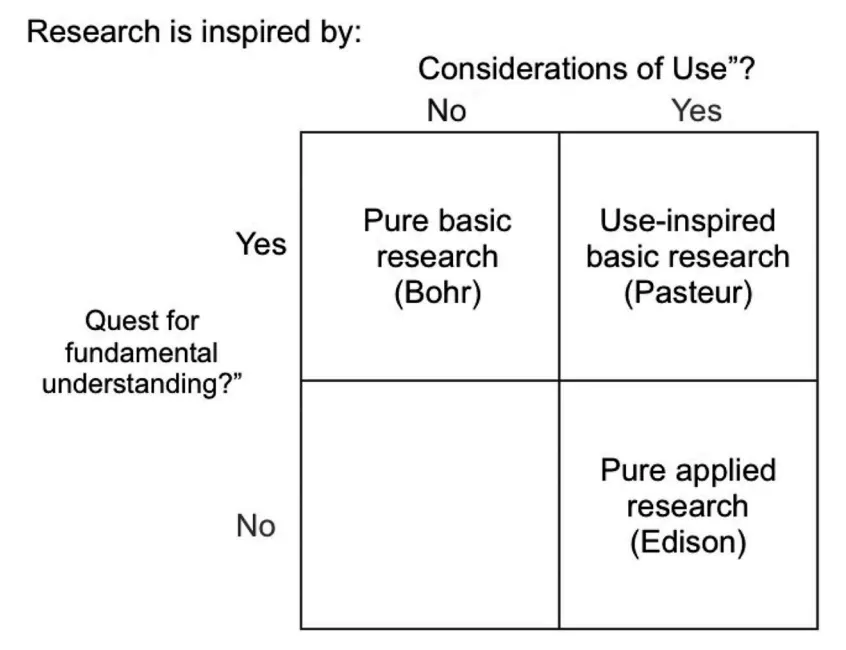
American science policy gradually evolved in a similar direction.
The postwar system institutionalized the Bohr function exceptionally well. The government financed fundamental research, and universities increasingly organized around its production. Yet over subsequent decades, especially beginning in the 1970s, additional institutions accumulated around it. Bayh–Dole strengthened incentives for universities to patent and license discoveries. Stevenson-Wydler, SBIR, industry-university cooperative research centers, SEMATECH, engineering research centers, manufacturing extension, state technology programs, university-industry partnerships, translational research, and later regional innovation programs all complicated the neat division between knowledge production and use.
The system did not abandon Bohr. Instead, it added Pasteur and Edison.
That is why one of the genuinely surprising aspects of OSTP’s new Science: A New Golden Age is its invocation of the linear model, as if American science policy has remained trapped within Bush’s institutional architecture for eighty years.
To its credit, the report itself rejects the model intellectually. My CSPO colleague Zach Pirtle, a boundary-spanning scholar of science, engineering, and philosophy, reading an earlier draft of this essay, was right to call attention to how unusual this is for a major federal science-policy document. A New Golden Age explicitly describes discovery as an iterative relationship among fundamental research, application, engineering, and industry. It recognizes that startups can conduct basic research, that engineering can generate scientific questions, and that technology and science have become deeply interdependent. It even gives serious attention to tacit knowledge, the skills encoded in workers, laboratories, and manufacturing practice that cannot simply be captured in papers and patents.
That makes its historical framing more puzzling.
The report presents itself as a fundamental rethinking of a system built around assumptions inherited from Bush. But the system has been adapting to the inadequacies of that model for half a century.
If we want to understand the present problem, 1945 may therefore be the wrong historical comparison.
The more useful place to look is the 1970s.
That ’70s show
Arthur Daemmrich, my other CSPO colleague and a scholar of the history of science and technology, made an important correction to an earlier version of this essay. I had described the competitiveness crisis primarily as a story of the 1980s. But the anxiety that ultimately produced many of the reforms associated with that decade had become acute earlier.
By the mid-1970s, the United States was confronting stagnant productivity, energy shocks, industrial competition, military concerns, and a growing sense that scientific strength was no longer translating automatically into technological and economic leadership. The Carter administration’s Domestic Policy Review of Industrial Innovation was already looking for institutional responses. According to Arthur, there was an explicit search for approaches that were less state-centric than traditional funding programs. Intellectual-property reform was one result.
Japan’s economic performance in the 1980s exacerbated the productivity problem.
American scientists and firms remained highly inventive, yet Japanese companies appeared increasingly capable of integrating research, engineering, suppliers, manufacturing, quality control, and long-term investment. By the mid-1980s, the gap was painfully visible in semiconductors: the transistor and integrated circuit had been invented in the United States, while Japan captured growing market share through superior manufacturing quality. SEMATECH emerged in 1987 as one response. By 1992, the Semiconductor Industry Association was developing an industry-wide roadmap intended to coordinate companies, SEMATECH, the Semiconductor Research Corporation, federal agencies, national laboratories, and research universities.
Not all these interventions worked. Some produced unintended consequences. Some were captured by incumbents. Some programs disappeared when administrations changed. Bayh–Dole strengthened commercialization but also helped make patents and licensing revenue convenient proxies for social benefit.
Yet the response displayed considerable sophistication about the problem.
It recognized that increasing the supply of basic research was not enough. The problem involved relationships among knowledge production, engineering, manufacturing, finance, users, government, and institutions.
This is where my dissertation began.
The perpetual struggle for fit
Drawing on the work of Christopher Freeman, Carlota Perez, Richard Nelson, Sidney Winter, Nathan Rosenberg, and others, I argued that technological progress alone could not sustain economic leadership. New technologies require complementary changes across organizations, institutions, production systems, skills, and public policy.
The social and institutional arrangements appropriate to one technological era may become inadequate in another. A country successful at borrowing and diffusing existing technologies may find that the same institutions are poorly suited to innovation once it reaches the technological frontier.
Technological change and institutional design are therefore engaged in what I described as a complex, ongoing struggle to keep pace with one another.
Freeman and Perez situated this struggle within successive techno-economic paradigms, or long waves. These should not be read as clockwork predictions that capitalism resets every fifty years. The more useful proposition is evolutionary.
Clusters of technological, organizational, and institutional innovations occasionally create new possibilities across large parts of the economy. When technologies and institutions become complementary, relative stability and rapid growth can follow. As that complementarity breaks down, a structural crisis emerges. Institutions created for yesterday’s technologies begin to obstruct tomorrow’s possibilities. A period of experimentation follows until a new alignment takes shape.
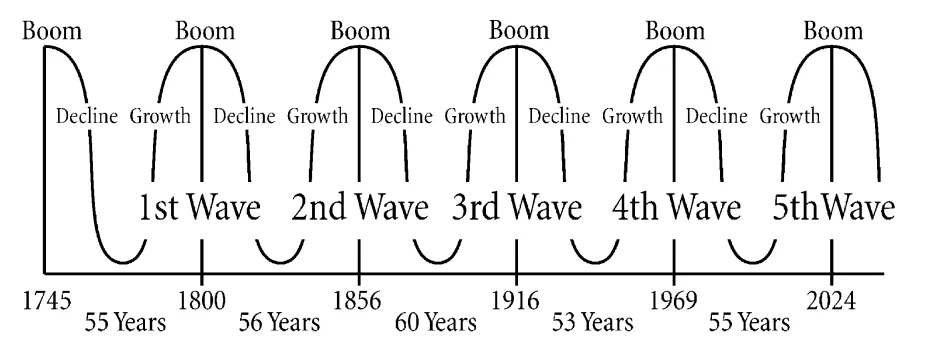
In other words, innovation has wave-like properties because the problem is not simply invention. It is fit.
That explains why science policy periodically rediscovers the same anxiety.
Are breakthroughs slowing?
Are competitors catching up?
Are our institutions obsolete?
The questions recur because the answers cannot be permanent.
Rate and direction
My dissertation was nominally about technological forecasting, but forecasting proved to be far less interesting as prediction than as institutional and network learning.
Postwar defense planners explicitly framed the problem as anticipating the rate and direction of technological change. Over time, approaches such as Delphi, roadmapping, and foresight sought different ways to organize knowledge about uncertain futures.
The more successful efforts did not merely forecast dates.
Motorola’s technology roadmap linked anticipated product requirements to scientific, engineering, manufacturing, and investment capabilities. Roadmapping helped communicate visions, mobilize resources, expose gaps, and monitor progress. Government foresight further expanded the field by asking how science and technology interacted with economic and social futures. Consultation and feedback mattered because the point was not to discover a predetermined future but to explore several possible ones and recognize that choices made today help create tomorrow.
This is where Science: A New Golden Age begins to feel incomplete.
It is very interested in the rate.
How can grants move faster? How can peer review become less conservative? How can researchers take more risks? Can AI accelerate discovery? Can alternative research organizations outperform conventional laboratories? Can metascience identify better ways to allocate federal research dollars?
These are important questions about inputs.
The report also outlines direction, the outputs. It identifies critical technologies, proposes missions and grand challenges, calls for precompetitive consortia, calls for rebuilding domestic manufacturing, and urges the government to build intentional research portfolios.
But strategies do not appear out of nowhere.
Who maps dependencies among scientific knowledge, manufacturing capability, supply chains, workforce, infrastructure, regulation, procurement, and users? Who identifies competing technological pathways? Who preserves minority views when consensus proves wrong? Who decides when a mission should change course?
As Arthur added to my earlier list: Who determines when projects are failing and when funds should be cut? Who decides when a program is finished?
My dissertation, building particularly on Don Kash and Robert Rycroft, described four adaptive functions of government: climate setting, surveying, coordinating, and gap filling. Surveying identifies technological opportunities and interdependencies that markets may not reveal. Coordination connects actors whose decisions depend on one another. Gap filling creates bridges where research, production, financing, regulation, or use fail to connect. Most importantly, these functions require continuous learning rather than a single policy correction.
The report contains many of the nouns of strategy—missions, portfolios, challenges, critical technologies—the “what”.
It needs more of the verbs—the “how”.
Japan, China, and different ways of dealing with uncertainty
The contrast with Japan is helpful here.
Japan’s rise forced Americans to confront an innovation system that seemed unusually adept at coordination. Japanese technology forecasting became institutionalized nationally as early as 1971. Government, industry, banks, suppliers, and manufacturers interacted through arrangements that American analysts studied closely. My dissertation documents how the national innovation system literature increasingly asked whether stronger coordination and systematic planning were becoming necessary features of a new techno-economic paradigm, building on the work of Chris Freeman.
Freeman’s chapter on Japan in Dosi, G. (1988). Technical change and economic theory (Image Source: Remembering Chris Freeman)
China presents a different challenge.
It would be wrong to say China has no strategy. It plainly does. But an important component of the Chinese approach is scale as a way of resolving uncertainty: invest broadly, build infrastructure, subsidize multiple competitors, tolerate duplication, manufacture at extraordinary volume, learn through deployment, and let production experience sort among competing trajectories.
One might call part of this a strategy of brute force and ignorance (BFI), not to imply that China lacks knowledge or planning, but rather that massive experimentation and production can compensate for not knowing in advance which technological pathway will win.
Brute force is still a strategy. Some scholars would argue that was the default U.S. science policy prior to 1945.
But it is probably not one the United States, with its declining social and institutional trust, can or should imitate in 2026.
America’s comparative advantage should lie in a different form of intelligence: pluralism, open criticism, strong universities, distributed industrial knowledge, federalism, entrepreneurial experimentation, roadmapping, foresight, and the capacity to learn across institutions and regions.
Which brings us to the dimension that Stokes did not include on his diagram, at least not explicitly.
Use for whom?
Stokes brilliantly showed that curiosity and use can coexist.
But use does not automatically align with public value.
A technology can be useful to a company and harmful to a community. It can advance national security while creating problems for law enforcement and civil liberties. It can build great antibodies for pathogens while creating risks for pandemics. It can generate economic growth while concentrating benefits geographically or socially. It can solve an engineering grand challenge without solving the problem with drinking water.
The OSTP report is not indifferent to social benefit. It wants manufacturing jobs, technical education, apprenticeships, greater participation in science, stronger regional economies, and technological gains that accrue to Americans.
But its account of benefit remains mostly downstream.
The questions are: How can Americans participate in new industries? How do we produce technology domestically? How can more people acquire the skills required by the new economy?
Those are legitimate questions.
They are not the same as asking who helps determine technological direction.
Who decides which AI applications merit public investment? Which energy futures should be pursued? When should communities participate in infrastructure decisions? What tradeoffs should guide biotechnology, nuclear energy, climate technologies, or automation? How should public benefits and burdens be evaluated before trajectories become difficult to reverse?
Stokes added use to understanding.
The next step is to add public value to use.
That is not an argument for replacing expert judgment with public opinion. Scientists, engineers, companies, workers, users, communities, and citizens possess different forms of knowledge. The challenge is institutional: how can those forms of knowledge be brought together at points where choices remain open?
My 2021 congressional testimony made this argument by calling for a research infrastructure capable of maximizing the public value of science. Producing public value requires capacity, incentives, professional roles, methods, and evaluation, just as producing excellent research and commercializing inventions do.
The same insight applies to universities. The Bayh–Dole and NSF Acts in the 20th century and the Morril and Hatch Acts of the 19th century showed that universities respond when federal policy legitimizes, funds, professionalizes, and renders certain activities legitimate and measurable. The next institutional innovation need not privilege another form of intellectual property. It could help universities become stronger boundary organizations that link knowledge production to firms, governments, workers, users, and communities.
The objective is not to add another burden to every research grant. It is to broaden what our innovation system can learn on top of what it already knows.
Science: A Long Wave
This is why I find Science: A New Golden Age both refreshing and strangely ahistorical.
It correctly recognizes that the linear model no longer describes the world. It understands that engineering and manufacturing matter. Its willingness to experiment with scientific institutions through metascience is welcome. It recognizes that the institutional machinery built for one era may inhibit progress in another.
But that insight is precisely why the story cannot jump from 1945 to 2026.
The intervening decades were not merely deviations from Bush. They were the American innovation system learning, albeit imperfectly, to adapt.
The battles that began in the 1970s produced institutional innovations in university technology transfer, collaborative R&D, manufacturing, roadmapping, foresight, regional development, and translational research. Some succeeded, some failed, and some solved one problem while creating another.
That is how long waves work.
Technologies evolve. Institutions catch up. The fit stabilizes. The technologies change again. The institutions become constraints. Another round of experimentation begins.
Bohr’s model did not become useless when quantum mechanics arrived. It became situated.
The same should apply to Bush.
Science, the Endless Frontier, gave the United States an effective model for one phase of American scientific development. Stokes helped give us a vocabulary for reconciling curiosity and use as the system evolved beyond that phase.
The challenge today is not to rediscover the linear model so that we can reject it again.
It is to understand the system that grew beyond itself and to ask what institutional innovations are needed for the next wave, perpetuated by a fundamental historical tension in the system between knowledge production and use.
The agenda can be stated concisely.
Rate: How can meaningful scientific and technological change happen faster?
Direction: Which technological trajectories should we pursue, and how will we know when to change course?
Public value: Progress toward what, for whom, and how to decide?
A new golden age will require answers to all three.