Cracks in the Wall, Bridges Over Troubled Waters
A recent LinkedIn post from the Democracy R&D Network made me think about an old problem—the dilemma of a science policy boundary spanner. The post referenced our recent Nature Commentary, which argued that “deliberation is not just a consultation tool but a way of democratising how evidence is produced, interpreted, and turned into policy.” In response to the post, Bjørn Bedsted, my longtime colleague from Democracy X, formerly the Danish Board of Technology, and a co-author of the article, commented that, “It is interesting to see how proponents of science advice are now arguing for combining it with public participation. Having worked with participatory Technology Assessment for 25 years, it has always seemed strange to me to keep those practices apart.”
Bjørn had me at “proponents of science advice.” Those of us who have worked for decades in participatory technology assessment have long wondered why these two worlds, the world of science policy advice and the world of public participation, were kept apart in the first place.
The wall was always artificial. But artificial walls can become institutionally real.
Science advice was treated as the place where evidence entered policy. Public participation was treated as the place where opinions, preferences, concerns, identities, and values entered policy. The first belonged to experts. The second belonged to democracy. Between them stood science communication, asked to serve as a narrow bridge over increasingly troubled waters: experts would produce knowledge, advisers would translate it into policy advice, communicators would explain it, and the public would hopefully understand, trust, and comply.
Those of us trained in, or shaped by, the social studies of science were never fully persuaded. Facts and values are not so neatly separated. Values enter in the choice of questions, the framing of uncertainty, the selection of endpoints, the interpretation of evidence, and the design of policy options. This does not make science arbitrary or merely political. It makes science human, institutional, and democratic.
For years, this view placed us in the minority. It questioned the status quo. It made science advice look less pure, and participation look less performative. It suggested that public participation was not merely a supplement to scientific evidence, but sometimes a condition for knowing what kind of evidence mattered.
This was not always a welcome argument in mainstream science policy (MSP).
Boundary Spanning at the Science and Policy Interface
It was during the early part of my current tenure. We were returning from an event in the Farragut area of Washington. Reflecting on the attention we just received, I was excited to tell Dan (Sarewitz) that our ideas are finally going mainstream. My wise mentor’s reply was short, surprising, and profound: “You really know how to hurt a guy!”
Dan’s point, which I neither had the experience nor the wisdom to fully understand and appreciate at the time, was simple: going mainstream comes with a cost.
In its mild form, it can be a barrier to creative solutions. In its severe form, it can lock you into a self-destructive sequence, as I tried to chronicle in my essay “How Science Got Lost.”
However, being the perpetual outsider is exhausting, if not demoralizing. Our work sits awkwardly between fields. Too practical for theory. Too theoretical for practice. Too critical for policy. Too technocratic for democracy. Never just right.
It isn’t just in the Washington S&T policy circles; it is true across all my professional spheres. Take the signature conference of all the communities of scholarship and practice where our participatory engagement work in science and technology intersect—the Annual Conferences of the American Association for the Advancement of Science (AAAS), the Society for Social Studies of Science (4S), the Atlanta Conference on Science and Technology Policy (ATLC), the Annual Conference of the Association of Science and Technology Centers (ASTC), or the Annual Conference of the Democracy R&D Network (DRND), we are rarely successful in having our symposium, panel or workshop proposals accepted without some strategic maneuvers. On a few occasions, when the gatekeepers let us in, our talks and sessions rarely drew an audience beyond our sympathetic colleagues. Similar stories can be told of our submissions to academic journals or science funding agencies.
Still, the outside teaches a theory of change that the center often forgets. You do not always move institutions by commanding them. You move by watching where the divides are, whether they are solid or porous walls, mighty rivers, or gentle streams.
I often thought that Brian Arthur’s depiction of the boundary-crossing problem, as quoted by M. Mitchell Waldrop in Complexity, provided a useful analogy: “If you think that you are a steam boat and you can go up the river, you are kidding yourself. Actually, you are the captain of a paper boat drifting down the river. If you try to resist, you are not going to get anywhere. On the other hand, if you quietly observe the flow, realizing you are part of it […], then every so often you can stick an oar into the river and punt yourself from one eddy to another.”

That may be the closest thing I have to a theory of change. From the outside, influence rarely looks like control. It looks like movement across currents: from science policy to public engagement, from technology assessment to deliberative democracy, from STS to federal agencies, from data to feelings, from treating facts and values as separate domains to treating them as parts of the same democratic problem.
Over time, several CSPO ideas that began at the edge of MSP became more legible over time. Anticipatory governance moved ethics from the study of downstream implications to integration across stages of innovation. Usable science reoriented “use” from expert-imagined applications to a process of co-production between the knowledge producer and user. Public Value Mapping broadened evaluation beyond scientific and market values to identify failures in public value. Participatory technology assessment combined expert assessment with social appraisals to manage sociotechnical uncertainty.
These were not four unrelated ideas. These are four ways of reopening questions that MSP had prematurely narrowed.
Interesting and more importantly, these reopenings were also made possible by public funding. This matters. CSPO’s outsider’s advantage was not heroic independence. It was its ability to chart an independent trajectory at semi-protected edges of the public funding system that allowed it to chip away at the status quo. NSF supported much of the conceptual experimentation in developing new tools for science policy, particularly through funding of social implications research for nanotechnology. Agencies such as NASA, NOAA, DOE, NIH, and others later provided applied contexts. Philanthropy, including Sloan, Kettering, and even the Charles Koch Institute, stepped in to fill gaps and extended the work.
Public funding, at its best, not only supports mainstream consensus. It can also trigger boundary crossings where the mainstream can be questioned, repaired, and sometimes renewed.
What COVID broke that needed breaking
Returning to Bjørn’s astute observation, I think what finally broke down the wall between science advice and public participation, in a measurable way, was the learning from COVID-19 responses.
The pandemic did not prove that experts were unnecessary. It proved the opposite. Expert knowledge was indispensable in first diagnosing the problem and stopping the worst and then developing a technical solution. But it also proved that expert knowledge alone was insufficient for solving the problem at scale. Getting people vaccinated, communicating uncertainty, understanding resistance, designing public-health measures, and sustaining trust required more than data, models, trials, and expert consensus. It required local knowledge, lived experience, community relationships, institutional memory, and democratic interventions.
In 2022, I saw the cracks coming to the surface at the National Academies workshop, Reimagining Science Communication in the COVID Era and Beyond. The workshop brought together researchers, practitioners, community members, and leaders to address the challenge of communicating science across communities in moments of crisis. Its stated purpose was not simply to improve messaging, but to clarify issues in equitable science communication and engagement, elevate promising approaches, and build relationships across sectors.
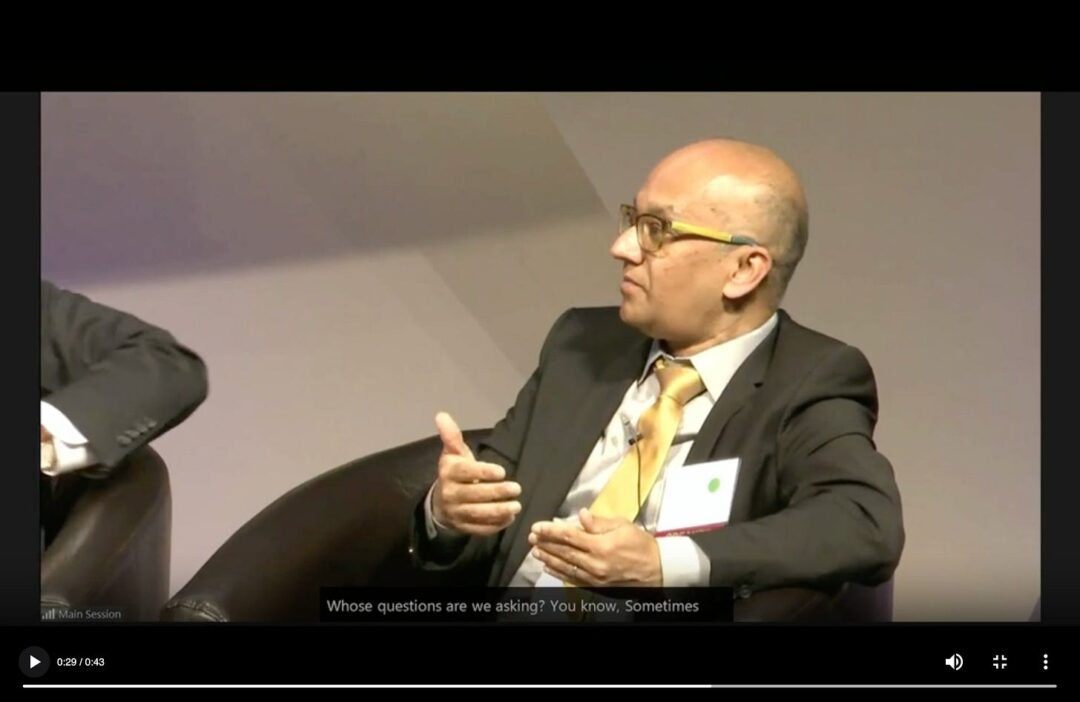
“Whose questions are we asking?” speaking at Reimagining Science Communication in the COVID Era and Beyond Panel Discussion in June, 2022 (Source: NASEM)
That shift mattered. For too long, the science communication problem was imagined as a deficit of public understanding. The public did not know enough. The public did not appreciate the evidence. But in my CSPO essay “Between Data and Feelings,” I tried to get at a different problem. Sometimes the data say one thing, and people feel another. The easy move is to call people irrational. The harder move is to ask whether the problem has been named and framed with them, or merely for them, or worse, at them.
In Vinton, Cumberland, Bisbee, Phoenix, Boston, and Zoom rooms filled with everyday people, we learned something that still seems too difficult for the MSP insiders to accept. If you begin by telling people what the latest science says about climate technology, autonomous vehicles, nuclear waste, or gene editing, you will get either compliance, resistance, or silence. However, if you start by asking them about their hopes and concerns, they often start thinking with you. Not always. Not magically. But when they do, it leads to places MSP would not take you.
At first, I feared that allowing people to question the questions would take us to La La Land. Instead, it gave us a clearer way to frame problems and a broader way to explore policy options. The choice is not between data and feelings. The task is to connect feelings with data.
What the Biden White House got right
To its credit, the previous administration helped build part of that bridge between science advice and democratic participation that is now inviting border traffic. The 2021 OMB equity report explicitly asked agencies to consider methods for assessing whether policies and actions create or exacerbate barriers to full and equal participation. The 2023 PCAST letter, Advancing Public Engagement with the Sciences, moved public engagement closer to the center of federal science policy advice rather than treating it as outreach at the end. Whatever one thinks of the administration’s broader COVID response or its politics of science, this was a real institutional shift.
But this bridge remains fragile. Participation can easily become a new vocabulary for old habits. Engagement can become trust-building for decisions already made. Lived experience can be honored ceremonially and ignored operationally. Public input can be invited only after the frame has been fixed, the evidence defined, and the policy options narrowed.
This was essentially the problem with how the United States and most Western countries approached the management of their high-level nuclear waste. For decades, the United States tried to solve the problem through its technical authority. Yucca Mountain became the emblem of that failure. The issue was not simply whether the geology was right. It was about whether a democratic society could accept a decision that many considered unfair. Consent-based siting (CBS) during the Obama administration emerged as an attempt to repair that history.
In 2016, we worked with DOE through the ASU CSPO-led Expert and Citizen Assessment of Science and Technology (ECAST) network to introduce a participatory technology assessment process to inform consent-based siting. The effort was promising, but fragile. Our later reflection showed how DOE’s process was constrained by expediency, limits on what could be discussed, bureaucratic barriers to collecting public input, lack of continuity across administrations, and insufficient commitment to procedural learning. DOE wanted public engagement, but the deeper institutional question remained: was the agency seeking social acceptance of a technically rational choice, or negotiating the technical feasibility of a societal choice?
That distinction still matters.
When the Biden DOE restarted consent-based siting with Congressional support, it incorporated lessons from the previous approach by proposing to fund regional consortia to support inclusive public engagement and feedback on spent fuel management. It also decided on an incremental approach, starting with interim storage before proceeding to a permanent repository. CSPO successfully competed to be awarded the lead for one of the 12 CBS consortia. Again, we proposed something very different from the other 11 consortia. Recognizing that the States needed to be an integral part of the solution and not an afterthought, the CSPO-led 3C-AZ consortia designed what a bottom-up, community-led, participatory process for generating consent through dialogue and deliberation could look like at the state level.
Our idea was ahead of its time by one administration.
What the Trump DOE Isn’t Canceling
After the 2016 election, the DOE didn’t even wait for the new Trump administration to be sworn in before canceling the Consent-Based Siting effort. Seeing the writing on the wall for a return to Yucca Mountain and a ‘decide and defend’ strategy, the Obama DOE on its waning days canceled what it had initiated. However, after the 2024 election, DOE under President Trump, instead of canceling what Biden restarted, decided to triple down on the ambition.
AI-driven electricity demand, renewed interest in advanced reactors, small modular reactors, fuel recycling, and the anticipated need for deep geologic disposal are pushing DOE toward a more aggressive nuclear agenda. In January 2026, DOE sought state interest in Nuclear Lifecycle Innovation Campuses that could include enrichment, fuel fabrication, reprocessing used nuclear fuel, waste disposition, advanced reactors, power generation, advanced manufacturing, and co-located data centers.
Here, democracy, technology, and markets are all forcing self-correction. Markets are pushing urgency. Technology is reopening possibilities. Democracy is forcing a new experimentation to solve an old problem.
Outsider’s Advantage
The two cases—science advice after COVID and nuclear waste after Yucca Mountain—are different, but they teach the same lesson. The mainstream did not change because outsiders won an argument. It changed because reality made the old separations untenable: between facts and values, between evidence and experience, between technical feasibility and public legitimacy, between science advice and democratic participation.
Democracy may not make science and technology self-correct faster. Often, it makes correction slower, messier, and more expensive. But it may also make the correction more real. Markets can accelerate a trajectory. Philanthropy can create a field. Technology can force urgency. But democratic engagement is often what reveals whether the trajectory has legitimacy.
That is the lesson I now take from the outsider’s advantage. The margin is not virtuous by itself. Some outsiders build public capacity; others bypass it. Some reopen democratic questions; others exploit institutional weakness to govern without accountability. The question is not whether an idea comes from the center or the margins. The question is whether it expands public reasoning or substitutes for it.
Dan was right. Going mainstream has a cost. The danger is that words like anticipation, participation, public value, consent, collaboration, and engagement can easily become institutional vocabulary without institutional absorption or learning.
But staying outside has a cost too. The point is not to remain marginal forever. The point is to preserve the outsider’s discipline: the habit of asking what the mainstream cannot yet ask, the patience to move when the current opens, and the humility to know that it will take a few punts to get there from here.