Past CSPO Events
- November 20, 2019CSPO DC
Putting Social Science to Work for Society
Fall 2019 Issues in Science and Technology Launch Event
Social science research—spanning disciplines as diverse as economics, anthropology, political science, and psychology—illuminates the inner workings of human behavior and society. How can this research be effectively applied to discover solutions to some of society’s most complex and formidable problems? And what role can universities play in transforming the social sciences into drivers of societal improvement?
These questions are at the heart of “Retrofitting Social Science for the Practical & Moral,” Kenneth Prewitt’s feature article in the latest edition of Issues in Science and Technology. Prewitt, a professor at Columbia University and former director of the US Census Bureau, will discuss his article at the launch event for the Fall 2019 Issues on November 20 in Washington, DC. He’ll be joined by Mary Ellen O’Connell (National Academies), Jed Herrmann (Results for America), and Toby Smith (Association for American Universities) in a wide-ranging exploration of how this research can better serve society.
Kenneth Prewitt, Mary Ellen O’Connell, Jed Herrmann, Tobin Smith
- November 06, 2019CSPO DC
Cooling a Warming Planet?
Results from Public Forums on Climate Intervention Research
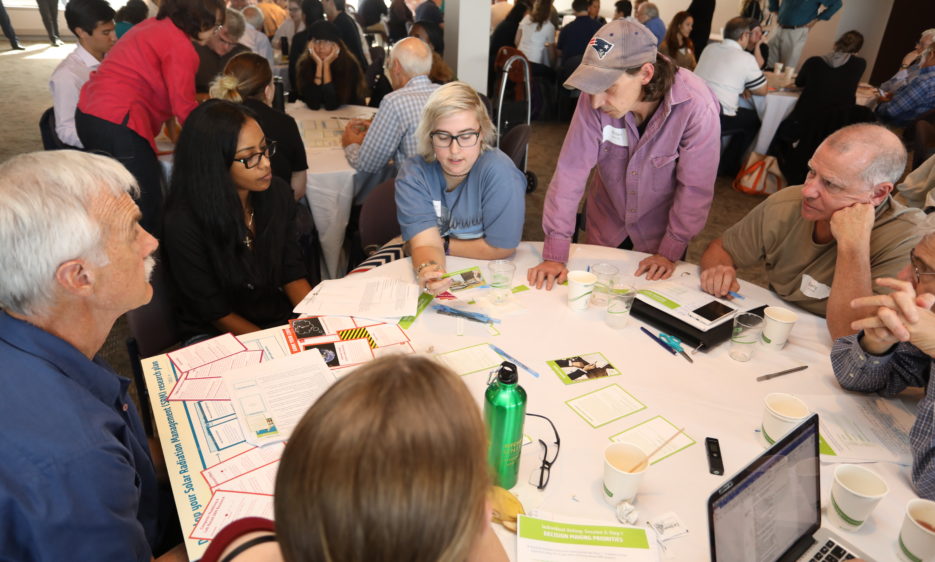
The scientific uncertainties and contested values surrounding geoengineering research, particularly for a class of methods called solar radiation management (SRM), make it a prime issue for which public deliberation can provide valuable input. With SRM research advancing to the field-research phase, the Consortium for Science, Policy & Outcomes (CSPO), with funding support from the Alfred P. Sloan Foundation, designed a set of public deliberations to explore questions of trust, transparency, consent, safety, collaboration, and other issues of importance related to SRM research.
CSPO convened groups of diverse citizens in two day-long forums to discuss SRM research in September 2018. The research team is now hosting a results launch event to share the deliberation results with SRM experts and stakeholders. Following a presentation of the high-level findings, a panel of experts will offer their reactions to the results report. All event participants will then have the opportunity to receive a copy of the final results report and ask additional questions.
Virginia Chanley, Jane A. Flegal, Frank Keutsch, Shuchi Talati
- October 21, 2019CSPO Conversations
The Science of Bureaucracy
Risk Decision-Making and the Legitimacy of the US EPA

Current headlines tell us there is a “war on science,” focused particularly keeping scientists of the Environmental Protection Agency (EPA) closely in check by those who want to contain federal environmental policies. But the history of science in the EPA tells a more complicated story of how science, in becoming central to the identity of federal bureaucracies, has long been evolving under a variety of pressures to maintain its status as a constitutive element of the agency’s legitimacy.
In this CSPO Conversations breakfast seminar, David Demortain (INRA) will discuss his forthcoming book, The Science of Bureaucracy. Risk Decision-Making and the US Environmental Protection Agency, and how the EPA has shaped the science of risk-based decision-making since its inception.
David Demortain
- September 12, 2019CSPO DC
How to Talk About Carbon Removal: Critical Questions About Climate Change Futures
Report Launch Event
Why do plans for keeping global temperatures below 1.5°C depend on the deployment of this hypothetical carbon removal and storage technology? Large-scale carbon capture has become an implicit, but critical, component of many climate proposals. No less an authority than the Intergovernmental Panel on Climate Change relies on unproven, uncertain carbon dioxide removal technologies to meet its ambitious targets.
Join Northeastern University professor Matthew Nisbet and the Institute for Carbon Removal Law & Policy for a discussion on a report in preparation, The Carbon Removal Debate: Asking Critical Questions about Climate Change Futures. The report works towards a common climate justice framework that can inform how various stakeholders think about, talk about, and act on this potentially transformative—but as yet still unproven—technology.
Matthew C. Nisbet
- May 28, 2019CSPO DC - New Tools for Science Policy
Empowering Communities to Shape the Future
The widespread perception that social and technological change happens to us rather than by us, and that it happens too fast, reveals a critical gap in science, technology, engineering, and math (STEM) engagement in the United States. Our educational system does not yet adequately support the development of futures thinking or a deep understanding of the relationship between STEM and society.
In this New Tools breakfast seminar, Rae Ostman and Paul Martin will discuss how the Center for Innovation in Informal STEM Learning at Arizona State University approaches the futures gap in STEM education, and describe how they are partnering with museums across the country to address it.
Rae Ostman, Paul Martin
- May 09, 2019—May 10, 2019CSPO AZ
CSPO 20th Anniversary Conference: Rightful Place of Science-2
This spring, two hundred people will come together in what used to be a desert to help chart the future of society and technology.
Second Decadal Rightful Place of Science Conference on May 9 and 10, 2019, in Tempe, Arizona.
If you enjoy jargon-filled talks and illegible PowerPoint slides, this is not the conference for you. But if you want to participate in a festival of brave ideas, challenging performances, weird technology, mesmerizing music and more, then JOIN US!
- May 01, 2019CSPO DC
Social Media, Artificial Intelligence and National Security
The Twelfth Workshop on the Social Implications of National Security (SINS19)
This workshop will first highlight the issue of social media and AI cases that have attempted to manipulate people and describe various influence campaigns through broadcast or microtargeting strategies. Workshop participants will then consider how governments and organizations are responding to the misuse of online platforms, and evaluate various ways in which AI-based social media might be regulated internationally. The responsibility of social media platform providers will also be brought into the discussion, as algorithms can detect bot-generated and dispersed information. Finally, strategies for preventing and counter-attacking disinformation campaigns will be considered in cases and contexts where such messaging becomes a destabilizing force in communications. Emerging areas of research, such as neuromorphic computing, will be discussed in the context of cyberwarfare and espionage.
Katina Michael
- April 26, 2019CSPO DC - New Tools for Science Policy
Gaming the Future
Re-activating creativity and play in professional spaces
Remarkable failures of foresight make headlines all the time. Despite access to powerful foresight tools, governments, companies, and individuals lack the capacity or the will to put insights about the future into practice.
In this New Tools breakfast seminar, Lauren Keeler argues that traditional foresight tools often do not effectively empower people to take action and they ask too little of people’s enormous capacity for creativity. Play, on the other hand, can motivate action, build connections, and spark innovation. Keeler introduces several games she has designed that guide individuals and organizations to envision new futures, reckon with potential shocks on the horizon, and engage in civil dialogue about important issues. Join us on April 26th to learn about these games and play them yourself!
Lauren Withycombe Keeler