Perhaps, but it shouldn’t aim to bypass the public and become corporations by another name
Three recent observations have made me rethink the role of philanthropy in science.
The first was a short exchange on X involving Jane Flegal. Jane’s point, as I read it, was not simply that philanthropy can do good or harm. It was that philanthropy at a very large scale starts to look like government. When private wealth is used to set priorities, build institutions, create markets, and shape public agendas, it is no longer just charity. It becomes a way of deciding what futures deserve to be built. Megan McArdle responded that she was comfortable with pluralistic, idiosyncratic philanthropy for reasons similar to why she preferred markets to central planning. Jane’s reply was the line that stayed with me: these are bad reasons to bypass democracy; philanthropy at this scale is governance without legitimacy or accountability.
The second was Jennifer Pahlka’s essay, Philanthropy’s Willie Sutton Problem. Her argument is simple and important: philanthropy cannot avoid government because government is where scale, implementation, money, and legitimacy reside. Serious philanthropy, therefore, has to work not only with government but also on government. That is exactly right. But it raises a democratic question: when does helping government strengthen public capacity, and when does it become private steering of public institutions?
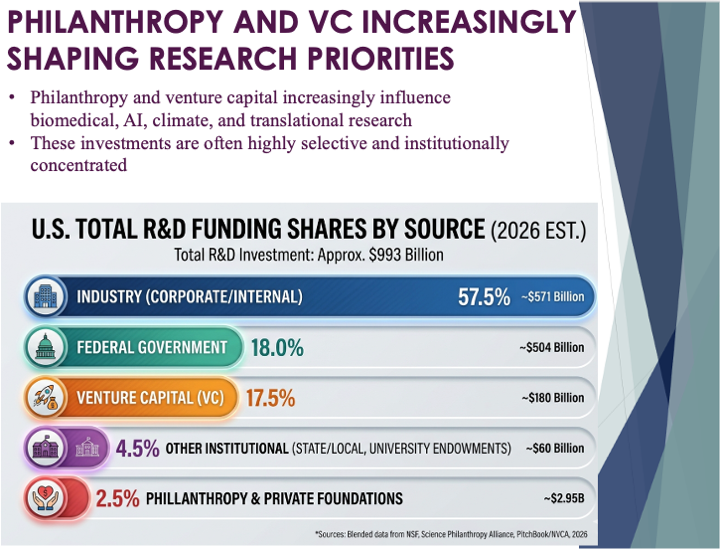
The third came from Maureen Kearney’s presentation at CSPO’s American Science @250 Public Forum Design workshop on June 18th, 2026. One slide put the issue bluntly: philanthropy and venture capital are increasingly shaping research priorities across biomedical, AI, climate, and translational research. These investments are often highly selective and institutionally concentrated. That sentence captures the governance problem. Philanthropy is not just filling gaps. It is increasingly helping determine which futures become investable, which institutions become influential, and which scientific agendas become urgent.
Back to 1999
These observations sent me back to an article I wrote in 1999 as a doctoral student at George Mason University (GMU). The article, which is not available in the archives, was about Non-Governmental Organizations (NGOs) in Bangladesh. At the time, I argued that NGOs had emerged in the 1970s and 80s as a correction to government failure. The state was incompetent, authoritarian, and often under military dictatorship; donors were impatient, and NGOs were more flexible and effective than public agencies. But over time, some NGOs shifted from complementing the state to substituting for it. They performed public functions without being accountable in the same way to citizens, markets, or democratic institutions—a state from which the public sector never truly recovered.
That is the state of play I now fear for American science philanthropy.
The United States is not Bangladesh in the 1990s. The analogy has limits. But the structural question is similar. What happens when outside actors step in to solve public problems because the government is slow, weak, polarized, or distrusted? At first, the intervention looks like a repair. Over time, it can become a replacement.
This is where Frank Fukuyama’s primacy of culture framework remains useful. I took Frank’s Culture and Policy course at GMU. He was also on my field committee. Frank argued that democratic societies depend on the consolidation of differentiated roles of state, market, civil society, and culture. The sectors can and should interact. But they are not interchangeable. When civil society performs state functions, when markets define public value, or when philanthropy builds governing machinery outside public accountability, the system may become more agile in the short run but less legitimate and less coherent over time.
So, the question is not whether philanthropy can do good. Of course it can. Philanthropy can fund neglected problems, support experimentation, protect fragile fields, and take risks that government cannot. The question is whether philanthropy strengthens democratic capacity or substitutes for it.
Operation Warp Speed
As a case in point, consider Operation Warp Speed for vaccine development (OWS), which is often invoked as a model for accelerating science and technology through public-private partnership. I recognize that this is more of a private-capital analogy than a philanthropy analogy, but it is useful for the public-interest vs. private-interest problem I would like to illustrate.
So, let’s recall what made OWS legitimate. Vaccine development during COVID responded to a clearly defined public-health emergency: mass illness, death, school closures, economic shutdown, and a collapsing health system. The government used private firms, but it did not simply hand the public future to private markets. It defined the public purpose, absorbed risk, coordinated agencies, funded development and manufacturing, and purchased vaccines as part of an emergency response.
Operation Warp Speed for carbon removal is an entirely different story. It may be necessary. It may deserve public investment. But the creation of carbon removal markets has not followed the same democratic path. There has been no comparable public settlement over how much carbon removal should matter relative to emissions reduction, who should pay for it, who should govern it, or which risks communities should accept. Instead, elite networks of philanthropy, technology firms, climate experts, and private buyers moved first. They created demand, selected promising pathways, defined quality standards, and built market confidence before the public had much opportunity to deliberate over the role carbon removal should play.
That is clever institution-building. It may even be necessary in the short run. But it also reveals the strategy’s democratic weakness. Operation Warp Speed mobilized markets in response to a public emergency. Carbon removal risks creating a public future through private markets.
In one case, private capacity was mobilized inside a publicly defined emergency. In the other, private capacity helped define the public problem itself. And when the government pulls back from carbon removal, what remains is not a democratically durable public program. What remains is private control: private buyers, private standards, private capital, private timelines, and private theories of the climate future.
This does not mean carbon removal is wrong. It means its governance is thin. If carbon removal is a public good, it cannot depend indefinitely on the private market. It needs public authorization, public accountability, and public deliberation. Otherwise, philanthropy and corporate buyers will not merely accelerate the adoption of a climate tool. In practice, they will decide which kind of climate policy survives when democratic government retreats.
This is the broader danger. Philanthropy can become complementary, compensatory, or substitutive.
Complement, Compensate, or Substitute?
Complementary philanthropy strengthens public institutions without replacing them. It funds public deliberation, independent evaluation, neglected communities, plural forms of knowledge, and institutional learning. It helps the government become more capable while leaving democratic authority intact.
Compensatory philanthropy fills temporary gaps when government is slow, underfunded, or politically constrained. This can be useful, especially in moments of crisis. But compensation becomes dangerous when temporary substitution hardens into permanent dependency.
Substitutive philanthropy decides what the public interest should be, builds the machinery to pursue it, and then uses government when available as an implementation vehicle. From inside the network, this can look like seriousness, ambition, and problem-solving. From the outside, it can look like an elite government without elections.
One can see this distinction inside science philanthropy itself.
One model tries to accelerate fields. It identifies promising technical frontiers, convenes experts and donors, builds funds, creates markets, and helps move capital toward selected priorities. This can be valuable, especially when public institutions are slow or underfunded. But it also sits close to the substitutive edge of philanthropy. It helps define public problems and mobilize solutions before democratic institutions or publics have had much chance to shape the agenda.
Another model tries to build civic capacity around science. It supports public engagement, community-based knowledge, journalism, deliberation, institutional learning, and the people who can connect science with democratic life. This model does not ask philanthropy to choose the future on behalf of the public. It strengthens the conditions under which publics and public institutions can reason together about science.
The difference is not between useful and useless philanthropy. Both can be useful. The difference is between philanthropy that accelerates preferred scientific futures and philanthropy that strengthens democratic capacity to choose among plausible futures.
This is where the scenario framework developed for anticipatory governance of human gene editing can be useful. The framework explores plausible futures around two axes: public versus private control and concentrated versus distributed power. The four quadrants were Safety First, Slow and Steady, Wild Frontier, and Winner Takes All.
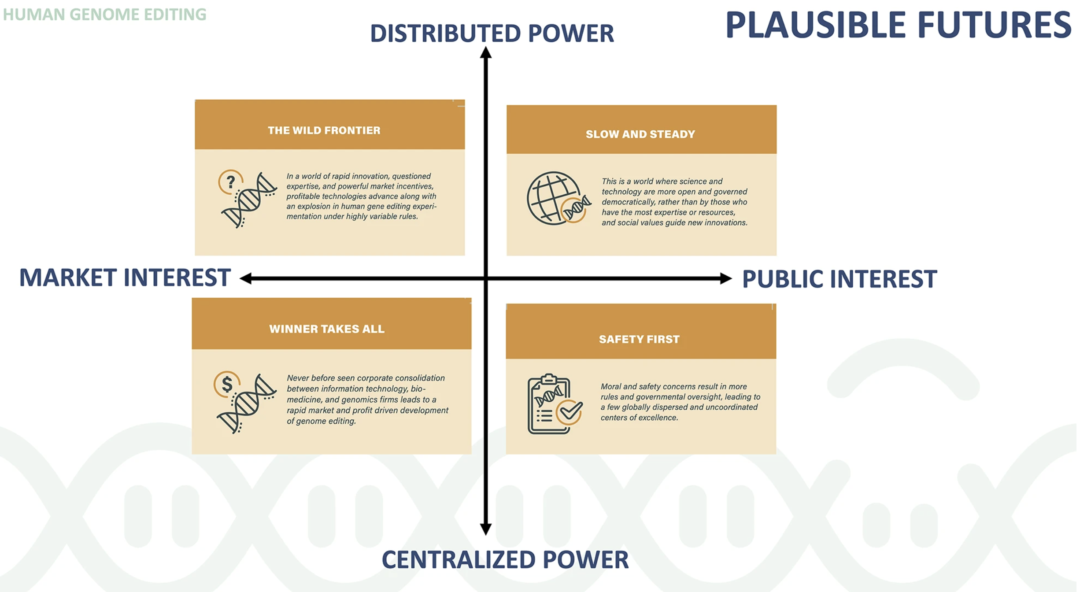
Philanthropy often imagines itself as rescuing science from the worst quadrant: Winner Takes All, where private control and concentrated power allow corporations, investors, or elites to shape technological futures with limited public accountability. But philanthropy can reproduce similar dynamics if it is privately controlled, institutionally concentrated, and insufficiently oriented toward public judgment.
That is the risk. Philanthropy can criticize venture capital and corporations while quietly adopting their habits: speed, selectivity, concentration, insider networks, heroic problem-solving, and impatience with democratic process.
The alternative is not paralysis. It is a democratic re-orientation.
A more democratic science philanthropy would treat public participation as agenda-setting rather than as outreach. It would ask citizens not only whether they accept a technology but also which problems they think science should solve, which trade-offs they are willing to accept, and which forms of expertise they trust. It would support public agencies rather than hollow them out. It would make influence visible: who funded the agenda, who convened the experts, who selected the questions, who benefits, who can object, and what happens when public deliberation changes the funder’s preferred path.
It would also fund pluralism. The public interest is not the same as scientific consensus, market opportunity, or elite agreement. Philanthropy should support competing visions, especially from communities and institutions that lack access to major donors.
This is where collaboration between government and philanthropy becomes delicate. Collaboration is not inherently bad. In many areas, it is necessary. Government provides capacity, philanthropy takes risks, universities sustain expertise, civil society surfaces values, and industry builds things. But the line between collaboration and collusion depends on accountability. Collaboration expands democratic capacity. Collusion narrows agenda-setting to insiders.
The central question, then, is not whether philanthropy should work with government. It must. The question is whether philanthropy helps government listen, learn, and act in public, or whether it helps a governing class move faster than democratic consent.
Philanthropy can help save science by rebuilding the democratic foundations of science: public trust, public capacity, public deliberation, and public legitimacy. But if philanthropy becomes the off-cycle home for scientific and technological agendas that cannot secure durable democratic support, it will not save science. It will save particular scientific priorities while deepening suspicion that science is something done to people by networks they cannot see, funded by donors they did not elect, and implemented by officials they cannot hold accountable.
That is not a recipe for saving science.
It is a recipe for losing democracy in the name of science.