Carbon Dioxide Removal (CDR) Technology Public Forums and Application to Governance Frameworks
Program Areas –
Project Summary & Interim Report
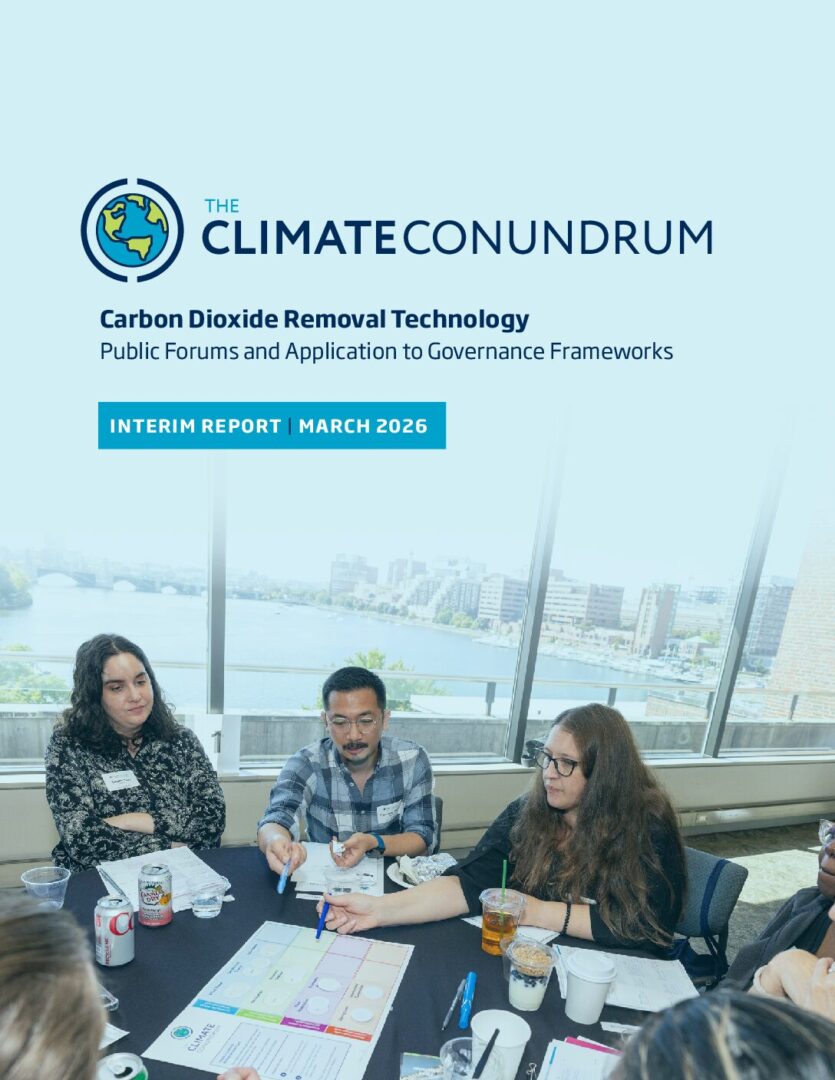 This project uses participatory technology assessment (pTA) methodology to explore how public opinions can shape emerging governance frameworks for Carbon Dioxide Removal (CDR) technologies. Conducted through a collaboration between Arizona State University, the University of Calgary, the University of Maryland, and the Museum of Science, Boston, the study was supported by funding from the Alfred P. Sloan Foundation and strategic initiative funds from Arizona State University. It combines expert analysis with organized citizen deliberation to understand how the public perceives climate intervention technologies and their governance.
Two citizen forums were held, one in Boston, Massachusetts (2024), and another in Vancouver, British Columbia (2025), drawing a total of 113 participants for a full day of discussion. Participants reviewed background materials, discussed climate mitigation strategies, and examined two representative CDR methods: Direct Air Capture with Carbon Storage (DACCS) and Ocean Alkalinity Enhancement (OAE).
Four key findings emerged from the forums:
- Participants favored a portfolio approach to addressing climate change. Participants repeatedly emphasized that addressing climate change needs multiple strategies. They focused on adaptation measures and emissions reductions, while CDR was mainly viewed as a supplementary tool rather than the main solution.
- Participants showed cautious openness toward CDR. While recognizing its potential to help reduce climate change, they also raised serious concerns about uncertainty and unintended consequences. “Unknown effects,” including ecological impacts and long-term system changes, were viewed as the most critical factors when evaluating CDR options.
- Trust in governance institutions is essential. Participants trusted universities, scientists, and public agencies more to oversee CDR research and deployment. Private companies were consistently seen as the least trusted actors. They emphasized the need for independent oversight, transparency, and robust monitoring and verification at this early stages of CDR research and development.
- Deliberative engagement increased knowledge but did not significantly change attitudes. Participants reported significantly greater familiarity with climate change and CDR after the forums. However, their overall opinions on CDR mainly remained the same, indicating that deliberative processes primarily serve as tools for collective learning and informed engagement rather than causing immediate opinion changes.
These findings highlight the importance of participatory approaches in guiding the governance of emerging climate technologies. As CDR shifts from research to potential deployment, incorporating public values into decision-making will be crucial for promoting responsible innovation and maintaining public confidence.
Explore public preferences in the interim report.
On March 26 – 27, 2026 CSPO hosted a public event “Engineering Our Planet: Lessons From the Engagement Frontier” to share results, lessons, and proposals from efforts across our climate intervention technology portfolio over the last few years to inform where we could go from here through engagements with experts and stakeholders in the broader planetary engineering community.
The event began with a presentation on these efforts at CSPO followed by a panel of colleagues who discussed their experiences in engagement. The panel consisted of:
- Lisa Margonelli, Moderator, Editor in Chief of Issues in Science and Technology
- Rory Jacobson, Head of Policy, Carbon Direct
- Emily Hostetler, pTA Project Manager, CSPO-ASU
- John Mimikakis, Vice President, Environmental Defense Fund
- Mara Karageozian, Associate Researcher, CSPO-ASU
- Amanda Borth, Fellow for Public Engagement in Science Policy, ASTC
- David Tomblin, Director of STS Programs, University of Maryland, College Park
Suggested report citation:
Borth, A., Hostetler, E., Farooque, M., Hubert, A.-M., & Tomblin, D. (2026, March). The Climate Conundrum: Carbon dioxide removal technology public forums and application to governance framework – Interim report. ASU Consortium for Science, Policy & Outcomes.