They were not the headliners. I expected the familiar: arrive, deliver remarks, affirm institutional commitments, depart. They did all the familiar, but then they stayed.
Three times, in three different settings, I found university presidents not just staying but listening. Not ceremonially, but substantively. Not as figureheads, but as participants in conversations that were, at times, uncomfortable, contested, and unresolved.
And each time, it caught me off guard.
The most recent instance was at Georgia Tech’s inaugural symposium on technology and civic leadership. The morning featured a high-profile dialogue between Cornel West and Robert George, an expansion of the arguments in their most recent book, Truth Matters: A Dialogue on Fruitful Disagreement in an Age of Division. When we broke for lunch, the hierarchy of the day had been established: the host, the President, the Chancellor, and then the main attraction, Robert George and Colonel West, all had taken their turns on the podium.
I was scheduled to speak on the second post-lunch panel, “Informing Public Debate: Lessons from the Intersection of Technology and Policy.” Sitting in the fifth row, listening to the panel ahead of me, I noticed something unusual: West and George were still seated in the front row, listening and engaging. They were modeling what they just preached about intellectual humility, that we are “listening in a truth-seeking spirit.” To me it meant actively and attentively listening to others, not only those with whom we may disagree, but also those who may not be our professional or intellectual equals, who may come from other disciplines or knowledge traditions, those who may not dwell in the high-minded ideal but the messy and mundane practical, in this case not just the why and what of civil discourse, but the where and how, the tasks left to the “implementers”, the engaged academic outliers like my fellow panelists and me.
I took note of that, determined to mention it if the two luminaries were still there when our panel’s turn came.
But what I did not anticipate was what I saw when we were seated to begin our panel.
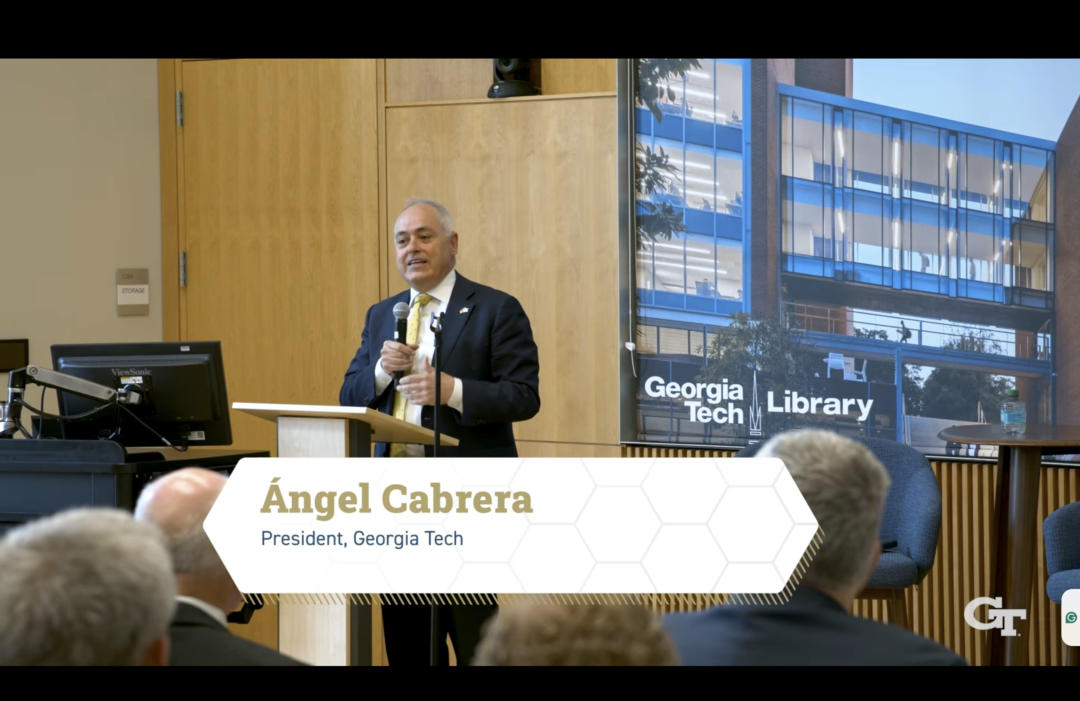
In the front row but not in the center, to my left, sat Georgia Tech President Ángel Cabrera—alone in a depleted row of reserved seats, attentive, taking notes. No entourage. No signaling. Just presence.
I wasn’t entirely certain it was him, since I had just seen him for the first time that morning. I decided not to call him out directly when I mentioned George and West. Instead, I made a broader point, building on his concluding line: an addendum to President Lincoln’s Gettysburg Address; we needed a government not just of, by, and for the people, but also with the people.
He was doing exactly that. The chief executive was “with” the implementers, listening, and practicing intellectual humility.
Beyond the Podium
As I mentioned in my lead, this was not my first recent encounter with university presidents in the audience.
The next most recent instance was last November, at Johns Hopkins Bloomberg School of Public Health, a JHU-AEI symposium on science, policy, and public trust in the wake of COVID.
President Ron Daniels opened with remarks. That was expected. What followed was not.
He stayed through panels that moved from generalities to contested terrain, including questions of trust, failure, and institutional credibility. When the formal program ended, he didn’t disappear. He joined the speakers and organizers for dinner, extending the conversation.
In a forum focused on public trust, his presence did what no speech could. It suggested that engagement was not performative. It was sustained.
Listening Before Leading
The third instance occurred at a National Academies workshop on Building Institutional Capacity for Engaged Research, in June, 2024. Here, the sequence was reversed. Panels first, reflections later.
Penn State President Neeli Bendapudi listened through hours of discussion about tensions among institutional incentives, community engagement, and what counts as knowledge before offering closing reflections.
What stood out was not only her remarks but also the listening that preceded them. During breaks, she engaged directly, asking questions and following up. At one point, she asked me to share my remarks on the long-standing tension between knowledge production and knowledge use in American universities.
It was a small exchange. But it reflected something larger: a willingness to engage before reflecting.
Looking Back at What They Said
These three moments stayed with me, not simply because of who these leaders were, but because of what they chose to do with their time and attention. In a sense, they had given me and others in those rooms the honor of being heard.
This is not the norm. The public compares universities to the ivory tower, but there are ivory towers within the ivory tower. I worked under a university president who wouldn’t meet privately with anyone who didn’t have “President” or “CEO” in their title.
So, I wanted to return the honor these three exemplars had just extended to my contemporaries. I went back and revisited their remarks. This time, not as a participant moving through a packed agenda, but as an observer trying to understand what linked them. What made these leaders stand out in a crowded landscape of capable, accomplished university presidents? What connected their presence in the audience to the ideas they expressed from the podium?
Cabrera: Civic Courage in a Technological Age
President Cabrera’s remarks at Georgia Tech make clear that this kind of presence is not incidental; it is also philosophical. He framed the university not as a purely technical institution but as a civic one, rooted in the unfinished democratic experiment. Drawing on Frederick Douglass and Martin Luther King Jr., he argued that democracy requires not retreat but engagement, “open dialogue, honest argument, genuine listening,” even amid disagreement.
What is striking is how directly this connects to our technological moment. Cabrera’s concern is not only polarization but also how digital infrastructures amplify division when optimized for outrage rather than understanding. In that context, the university’s role is not to withdraw into expertise but to actively cultivate the conditions for democratic discourse. His presence in the audience, listening and taking notes, was not symbolic. It was an enactment of that civic commitment.
Daniels: Universities as Arenas for Democratic Contestation
Ron Daniels’s remarks sharpen this argument by placing universities at the center of democratic life, precisely because of the current crisis of confidence. He openly acknowledged that confidence in scientific expertise has eroded and that universities have not fully met their responsibilities. But his response is not defensiveness or insulation; it is openness. Universities, he argues, must be places where even uncomfortable and dissenting perspectives receive a fair hearing and where ideas are tested across lines of difference.
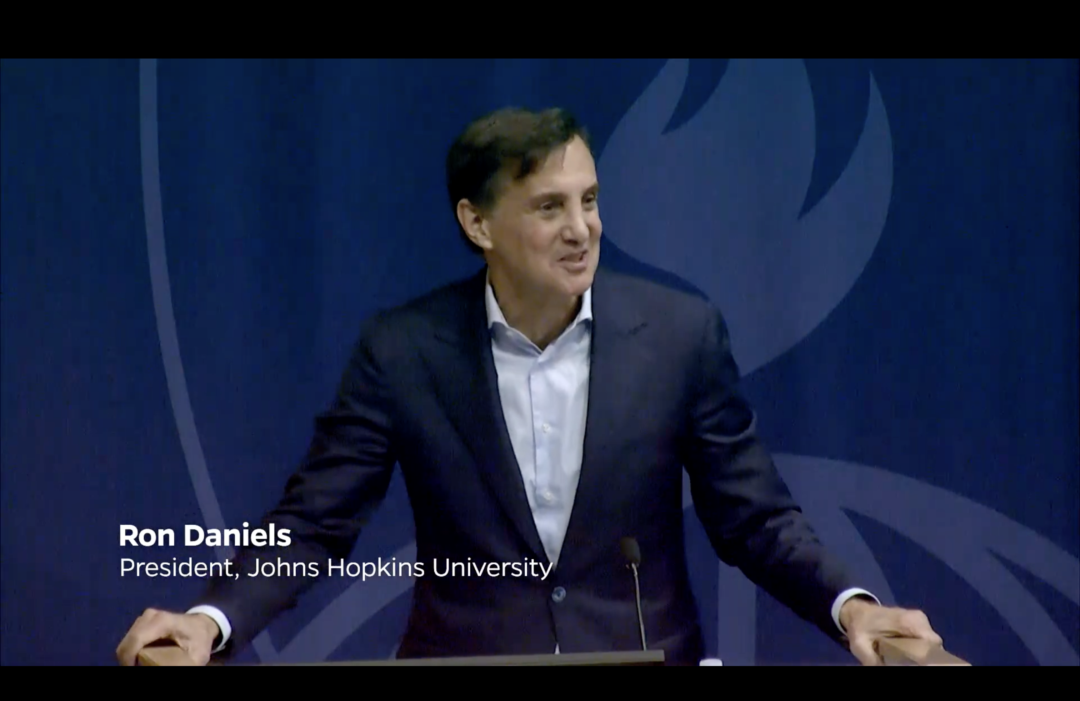
His emphasis on collaboration across ideological divides reflects a deliberate effort to resist intellectual siloing. This is not about consensus; it is about legitimacy. In a pluralist democracy, trust is not restored by asserting authority, but by demonstrating a willingness to engage criticism and competing values. His decision to remain throughout the event mirrored that commitment.
Bendapudi: Rebuilding Trust Through Public Engagement
Neeli Bendapudi’s intervention addresses the same problem from an institutional and strategic perspective. She identifies declining trust in expertise and skepticism toward higher education as an existential challenge not only for universities but for democracy itself. Her response is to advance public impact research while insisting that expertise alone is insufficient. Universities must be seen as both competent and well-intentioned.
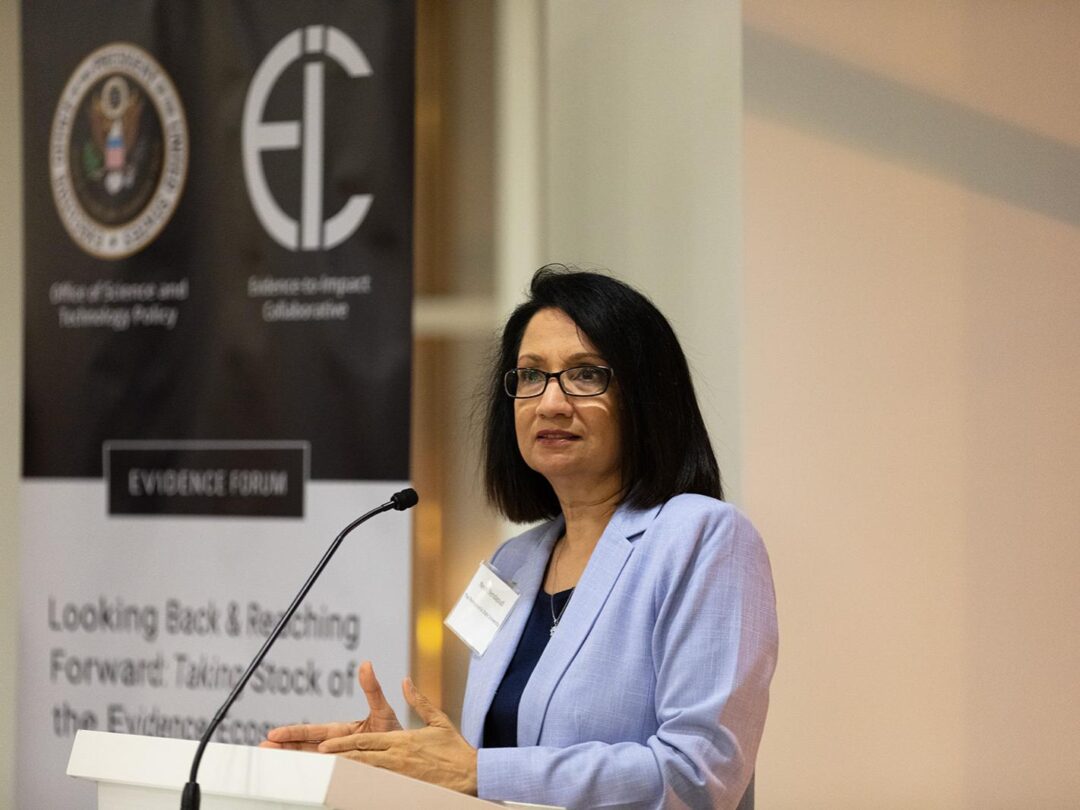
This reframes the university’s role from knowledge production alone to building relationships with society. Engagement is not an add-on; it is central to restoring legitimacy. Her emphasis on systemic solutions and institutional change reflects recognition that this work must be sustained, not episodic. Her listening to and engaging with the participants throughout the workshop were consistent with that vision.
A Common Thread: Leaving the Ivory Tower
Taken together, these three perspectives converge on a common insight: universities cannot retreat from society at a moment when society is questioning them. The response to anti-intellectualism, populist skepticism, and declining trust is not to defend the ivory tower but to leave it.
What I witnessed in these three instances was a form of leadership that accepts the risks of engagement, entering spaces of disagreement, exposing oneself to critique, and relinquishing the comfort of institutional distance.
Cabrera frames this as civic courage in a technologically fragmented public sphere. Daniels frames it as the university’s obligation to host and sustain democratic contestation. Bendapudi frames it as rebuilding trust through public engagement and institutional transformation.
All three points in the same direction.
In a democracy under strain, the role of the university is not only to produce knowledge but to create, as Robert George insisted, first the conditions under which “settled” knowledge can be questioned, debated, verified, and if necessary, unsettled, and second to commit most earnestly to virtues like intellectual humility. That requires more than speaking.
It requires showing up. Listening. And staying in the room when the conversation becomes difficult, or different, or not on the same level. It requires leading by example.