My science policy friends seem convinced that invoking Vannevar Bush and showcasing a bipartisan parade of former presidents’ support for science will restore public consensus. I doubt it.
Last Friday night, June 12th, I attended the Washington premiere of The Endless Frontier, Marilyn Ness’s new documentary about three scientists in immunology, neurorobotics, and ocean science. The film follows Andrea Graham of Princeton, Jacob George of the University of Utah, and Paul Barber of UCLA as instability in the American research system disrupts their work and the lives of those who depend on it.
It is a moving film with stunning cinematography. It does an excellent job of humanizing scientists. They have families, doubts, ambitions, and personal histories like everyone else. Some have risen from unlikely beginnings to the pinnacle of success and now want to create opportunities for people in marginalized and disadvantaged communities. Their research could improve lives. Their plans have been disrupted by funding cuts and political uncertainty, and they have joined the movement to put science back in what they believe is its rightful place.
Those of us who conduct, fund, use, manage, or study science, research, and policy will recognize these people immediately. We will understand what is being lost when laboratories stop hiring, projects are postponed, and young researchers reconsider their futures.
But are we the ones who need convincing?
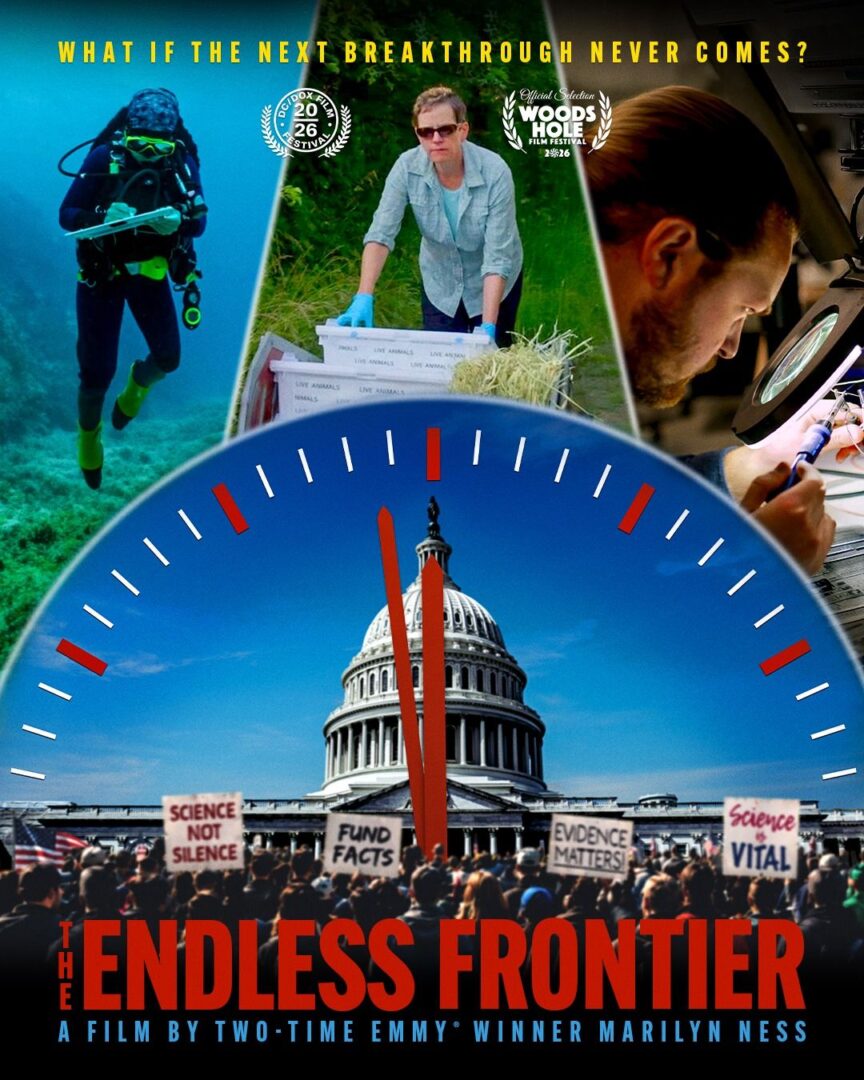
The people who need convincing increasingly view scientists as culturally elite, institutionally powerful, and eager to instruct the rest of society on climate change, COVID-19, diversity, gender, and other progressive causes. Showing them three admirable professors at Princeton, UCLA, and Utah is unlikely to change that perception. At best, the film may persuade a few more people who already support science to attend the next Stand Up for Science rally.
That matters. Solidarity matters. But mobilizing the faithful is not the same as rebuilding public legitimacy.
Meeting Sally
On January 20, 2025, late in the afternoon, I was waiting in the TSA Precheck line at Reagan National Airport. I was flying to Stanford for a workshop on atmospheric methane removal that began the following day.
The line was moving slowly because an older woman ahead of me was having difficulty getting through security. Let us call her Sally.
From a distance, it looked as though she needed assistance. Conscious that she was holding people up, she kept allowing other passengers to pass while trying to organize her belongings. When I reached her, I had plenty of time before my flight, so instead of going around her, I waited.
Sally did not have a carry-on bag. She had a water bottle, a partially eaten sandwich, or perhaps a doughnut, some candy, and a handful of small objects she was trying to fit into one of the trays for wallets and phones. She discarded the water, removed her cap, and eventually squeezed everything into the tray.
I followed with my backpack and carry-on. When her tray appeared on the other side, Sally looked relieved. She put everything back into her jacket pockets and put her cap back on her head.
It was a red Make America Great Again hat.
Only then did it occur to me that she had likely attended the inauguration and was now heading home. She did not strike me as a frequent traveler. Coming to Washington may have been unusual for her. But Trump’s victory was also, in a sense, hers, and she had come to witness it.
On the plane, I kept thinking about Sally.
I knew nothing about her politics beyond the hat. I did not know where she lived, why she supported Trump, or what she expected him to do. But she came to represent, in my mind, a part of America that felt ignored by the institutions that governed it and believed Trump was finally listening.
Whether he is actually helping people like Sally, exploiting their grievances, or using that promise to enrich himself and those around him is a separate question. But bringing citizens who feel abandoned by both parties into political participation is not, by itself, harmful to democracy. The harder question is why so many of our institutions failed to make them feel represented.
What would Sally see in The Endless Frontier?
Would she see three generous and accomplished human beings trying to improve the world? Perhaps. Or would she see another defense of institutions whose leaders have repeatedly told people like her to trust expertise, follow the science, and leave the important decisions to those who know better?
The Grievances Science Would Rather Avoid
My science policy friends in Washington seem convinced that invoking Vannevar Bush and showcasing a bipartisan parade of former presidents’ support for science will restore public consensus behind science.
I doubt it.
We cannot resolve the current crisis by endlessly invoking Science, the Endless Frontier. The postwar compact was never as politically innocent as its admirers remember. As Dan Sarewitz argued in “Saving Science,” Bush’s promise that the “free play of free intellects” would reliably produce the knowledge society needed was a beautiful lie. It protected scientific autonomy by obscuring the political choices, institutional demands, and public purposes that have always shaped research.
Nor can the scientific community rebuild trust by refusing to address the grievances accumulated during the pandemic: the lab-leak controversy, government pressure on social media platforms, shifting claims about masks, prolonged school closures, vaccine mandates, and the tendency to present contested policy judgments as if they followed automatically from “the science.”
These issues are not all equivalent, and the most extreme allegations are not necessarily true. Yet they have become part of the country’s political memory. They cannot be erased by labeling everyone who raises them as ignorant, misinformed, or anti-science.
The scientific community does not have to accept every grievance. It, however, does have to address them.
The Question in the Room
That was what seemed missing from the discussion following the film. The panel featured the director, two of the film’s scientists, and Francis Collins. It was largely a conversation among people who shared the same diagnosis.
But the skeptical public was not entirely absent. It surfaced in the first audience question.
The questioner responded to Collins’s claim that Trump voters believed scientists were hostile to religion. That, the questioner suggested, was not the real reason science had lost public support. He then asked why Collins had declined to participate in “Bridging Perspectives in COVID’s Wake,” a Johns Hopkins–American Enterprise Institute symposium convened to examine pandemic decisions, dissenting perspectives, and public trust.
Unfortunately, I had to leave before hearing either the full question or Collins’ answer. I therefore cannot judge the exchange or independently confirm the premise that Collins refused an invitation.
But the intervention itself was revealing.
Even among a Washington audience likely to be sympathetic to the film, there were people who were not opposed to science but remained deeply troubled by how scientific authority had been exercised during the pandemic. They wanted to know why leaders who now lament the loss of public trust appeared unwilling to engage with critics who believed dissent had been marginalized, censored, or dismissed.
The questioner may or may not have been fair to Collins, but he asked precisely the question the panel needed to confront: Can scientific leaders rebuild trust without sitting down with people who believe those same leaders helped break it?
Collins also summarized one of his lessons with a familiar formulation: “When you mix science and politics, you get politics.”
I think that statement sums up the problem, although not in the way he intended.
Science and politics have always been intertwined. Congress decides which purposes merit public funding. Presidents set priorities. Agencies translate those priorities into programs. Scientists assess evidence and scientific merit. Citizens live with the consequences.
The problem is not that politics has entered a previously pristine scientific domain. Rather, it is that the scientific establishment has often treated its own political commitments as neutral while recognizing politics only when its opponents hold power.
The Wrong Scientists?
The Trump administration’s attack on American science is real. Laboratories have lost grants, agencies have lost personnel, careers have been interrupted, and students and postdoctoral researchers face extraordinary uncertainty. The new OMB proposal would deepen the damage by requiring senior political appointees to review discretionary grants for alignment with presidential priorities and by reducing peer review to an advisory role.
That is not democratic accountability; it is partisan control.
Yet the film’s strongest examples are established professors who remain employed and able to continue much of their work, albeit under painful constraints. Their disrupted plans matter. But if the goal is to show what dismantling the research system is doing to people, the more compelling protagonists may be elsewhere: the postdoctoral researcher whose position disappeared, the graduate student whose experiment was interrupted midway, the federal scientist who lost a career, or the young investigator whose first grant was terminated.
The film asks us to imagine what America might lose in the future. Those people could show us what we are already losing now.
Beyond Restoration
The choice before us is not between an apolitical scientific establishment and Trump’s political science. Both are inadequate.
Political appointees should not decide whether individual research proposals are scientifically meritorious. But scientists cannot, by themselves, decide which purposes merit public investment or which values should govern technological change.
Scientists should judge scientific merit. Congress should define public purposes. Political appointees should administer those purposes transparently. And citizens should have meaningful opportunities to deliberate on the values and futures at stake.
That is the compact we have not yet built.
The defenders of science want to restore what existed before Trump. Sally reminds me that restoration may not be enough. The old system produced extraordinary knowledge, medicines, technologies for national security, and prosperity. It also left many Americans feeling that decisions were being made by institutions that neither knew them nor listened to them.
Another documentary celebrating scientists will not resolve that estrangement. Another march may demonstrate the strength of the scientific community without expanding its constituency. Another invocation of Vannevar Bush will not answer grievances that emerged decades after his death.
The endless frontier was discovery. The next frontier is engagement.
Until the scientific community is willing to cross it, we may keep standing up for science while wondering why so many Americans remain seated.